
At the turn of the 20th century, Irish playwright George Bernard Shaw wrote that “[h]appy is the man who is living by his hobby”.
Nowadays, we’ve become more gender-aware and gender-sensitive, but the essence of his message remains as true as ever: cultivating our hobbies makes us all – men and women – happy.
As a matter of fact, when we think of hobbies, we can immediately visualise a relaxing activity like reading, spending time with friends while sipping our favourite drink, or trying to improve in a sport we love.
But as it turns out, hobbies also have a deeper side, which throws some light on our personality and especially our conflict resolution style. In this sense, hobbies can assist in the recruitment process to pick the most suitable person for the job.
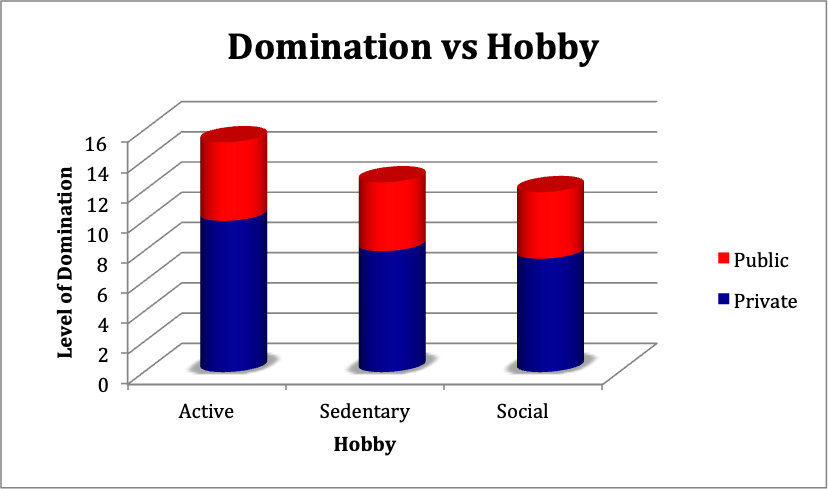
Last year, we shared the results of our research showing a direct correlation between active hobbies and domination levels for the CSRs working in the contact centres of one of the UK’s ‘Big Six’ utilities.
This year, we’re able to compare these data with those obtained from the study we’ve been carrying out in the Government Agency we’re currently working for.
The new results confirm that contact centre advisors who engage in active hobbies (such as playing sports or doing outdoor activities) tend to be more dominant than those who prefer sedentary (for example watching films and drawing) and social hobbies (e.g. social drinking, eating out with friends).
He Said, She Said
Recently, I’ve been extremely concerned by the current philosophy that you should treat everyone the same. I don’t know about you, but I wouldn’t speak to my 90-year-old grandmother the same way I would my 10-year-old granddaughter. This lack of sophistication and subtlety would fly in the face of common sense. It’s just plain silly. No professional communicator would promote the idea.
But the current social trend is to speak exactly the same to men as to women, eliminating any stereotypical or gender bias from conversations.
Let’s not forget that recently Google sacked one of its employees because “portions of (his) memo violate our Code of Conduct and cross the line by advancing harmful gender stereotypes in our workplace,” according to Google’s Chief Executive Sundar Pichai.
Increasing social awareness of gender-bias in language has been a delicate subject for some time. But political correctness gone mad is not advisable either.
Replacing Spotted Dick on a Council menu with Spotted Richard elevates the need to police words to the ludicrous. Flintshire Councillor, Klaus Armstrong-Braun, criticised the ban on the original name of the pudding. He said, that the bosses who had made the decision would soon be “frightened of their own shadow.”
Way back in the 18th Century, Samuel Taylor Coleridge warned, “Every reform, however necessary, will by weak minds be carried to an excess, that itself will need reforming.”
And in our own time, Charles Kennedy remarked that, “The growing influence of focus groups means we are all in danger of being excessively cowed by their feedback.”
It’s curious that no matter how often eminent neuroscientists, brain surgeons, and psychologists (using modern, scientific technology) tell us that the brains of men and women are wired differently, you can find yourself up against the age-old conundrum. Science verses Ideology.
This is an important issue in customer communication. Should companies train Customer Service staff to have a one-size-fits-all conversation with customers, or should they go for a more sophisticated approach that flexes to the personality, age, intelligence and gender of the customer?
Psychologists have always been interested in individual differences. In fact, Edinburgh University currently offers a Masters in the subject. It’s long been a subject of research in this field.
So we thought we’d do a bit of research of our own and where better to start than in a Government Agency which takes 12.5 million calls a year from 45 million customers. It’s a sizeable number of callers.
Each member of the 1,100 strong Call Centre Team speaks to roughly 150 people a day, from all parts of the country, from different ethnic and socio-economic groups, and of all ages and genders.
Over a period of 14 months, we conducted a survey to establish if agents felt they spoke differently to men and women when they called in, and if men and women spoke differently to them. We were looking for trends. Trends that might confirm or negate other research in this area.
Result One
Only 36.89% of the agents said they speak in the same way to men as they do to women.
Almost a half, 46.72%, said they adjusted their conversations to the genderof the caller.
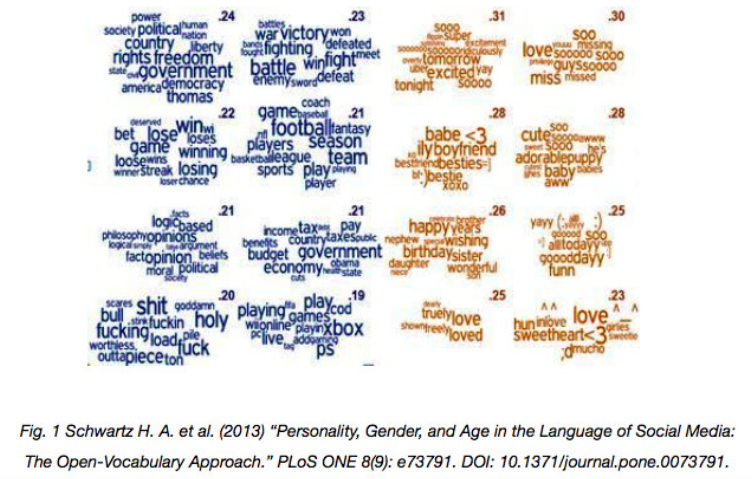
This is interesting in the light of research carried out at the University of Cambridge and the University of Pennsylvania which studied 700 million words and topics from 75,000 Facebook volunteers. Men (blue text) talk about politics, sport and competitive activities. Women (gold text) talk about personal concerns, relationships and emotions.
The contrast is quite clear and whilst it’s a given that not every single person will fit exactly into this pattern, the overall trends indicate there are general trend for men and women to be interested in different things.
Result Two
So if the general trend is for men and women to talk about different subjects, are there any differences in the style of communication each gender uses?
It seems so. Over half the agents reported that men are direct, to-the-point and business-like, 55.37%.
This compares to only 20.66% who said women’s conversations were factual. This is a striking difference.
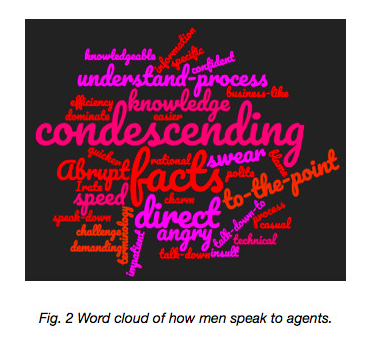
Figure 2 clearly reveals that agents feel men are inclined to take a superior tone, to become angry and abrupt and to talk down to call centre staff. It seems men’s conversations are driven by a need to control or dominate.
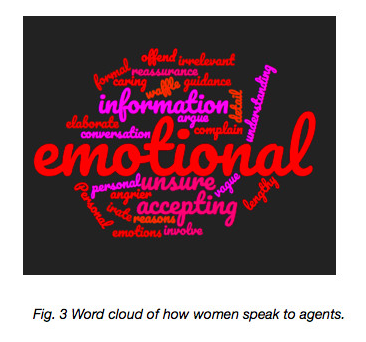
Figure 3 confirms what previous research has uncovered many times. Agents thought women were less assured than the men, less confident and more emotional during calls. Naturally, not all women fall into this mould, but many of them do.
So it behoves the agents to understand these general trends but to adjust their conversations to the personalities of individual callers.
Moreover, according to 65.3% of agents, women supply personal informationduring calls. Only 10.74% of men do. This trend is highly significant.
Rapport and empathy depend on understanding people and the more you know about them, the greater your ability to tailor your conversation to the individual at the end of the phone. This is what makes for ‘best in class’ calls and transforms the customer’s experience so that they feel more than just a number.
Result Three
Finally, we asked agents to think about the situation from the opposite angle. Rather than focusing on whether they spoke differently to men and women callers, we asked if men and women who called in spoke differently to them.
A huge majority – 70.24% – said Yes. Men and women do engage in different styles of communication. Only 16.52% said No.
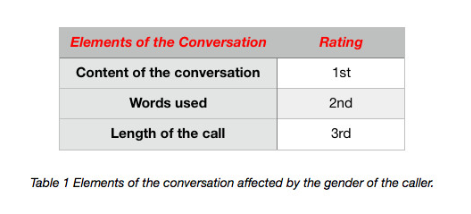
Depending on whether the caller is a man or a woman, agents said three elements of the conversation are affected. They are ranked in order of importance in Table 1.
Clearly, the overall nature of the conversation is at the top of the list, with words and the length of the conversation in second and third place.
That is the entire content of the call is affected by the gender of the caller.
So a one-size-fits-all style of communication would be a foolish road to go down. In fact, no research to date has shown that men and women talk about exactly the same things, in the same way and with the same emotional / attitudinal bias.
Corporate communication, particularly in Call Centres, Complaints Teams and in Customer Service Departments does need to be sophisticated, subtle and sensitive.
No amount of ideology can withstand the forces of human nature, or reset the behavioural instincts programmed into the human brain by 200,000 years of evolution.
Dr Valerie Bram is a Director of T2 Linguistics Ltd (www.t2linguistics.com) and a specialist in Psycho-Linguistics. Contact: valeriebram@t2linguistics.com.
Writing is Back
What goes around comes around as they say. Writing, so long the poor relation in customer communication, is back in favour.
Over the past twenty years the pendulum has swung away from the written to the spoken word, and all the way back again. Ubiquitous emails, dynamic Live Chat, and frenetic texting have transformed corporate communication. Opposable thumbs could soon find themselves in the Olympics and Text Speak could become part of the school curriculum.
Back in the day, we learned grammar in school. Parts of speech, clause analysis, identifying grammatical errors were easy peasy for us. But all that changed when Creative Writing galloped onto the scene. Several generations have missed out on grammar, unless they did French, or German.
That’s why it’s difficult to explain why, ‘With reference to your email of 16 September 2017.’ isn’t correct. Where do you start? With the components of a sentence? With the need for a verb? A finite verb?
Trying to eliminate poor writing in companies is a Herculean task on much the same scale as cleaning the Augean Stables.
It’s like trying to teach a mechanic to service a car without labelling parts of the engine.
Apart from the technical accuracy of the text, something journalists call ‘Clean Copy’ – don’t you just love the phrase? – there’s the content to consider.
Those of us who write, love to quote the American journalist and author, Gene Fowler, who famously said, ‘Writing is easy: all you do is sit staring at a blank sheet of paper until drops of blood form on your forehead.’
Writing is hard work. So even if you have a Hemingway, Twain or Blake on your Customer Communication Team, you can be sure they won’t be happy with the first version of anything they write. These stellar authors produced dazzling prose that was edited, polished and re-worked to within an inch of its life.
And that’s what a lot of people writing to customers don’t realise. The perfect message is not going to be your first attempt, nor necessarily your second. The perfect message demands mastery of content, style, rhythm and pace. Plus an understanding of how words effect customers – emotionally.
Robert Louis Stevenson said, ‘The difficulty of (literature) is not write, but to write what you mean: not to affect your reader, but to affect (him) precisely as you wish.’
It is possible to train Customer Correspondence Teams to write at this level. Some time ago the editor of The Economist wrote to the MD of Thames Water after receiving a letter from a delegate who had taken part in one of our seminars.
He said:
The attached letter gave me a shock – a most agreeable one.
I confess I fully expected either no answer, or the usual sort of standard, off-the-point, get-this-fellow-off-our-backs one that comes from most organisations. Instead I got the thoroughly sensible, non-standard, thought-out letter, directed to the question I’d asked and giving it a persuasive answer.
Please pass on a pat on the back to your customer relations people, as confirmation that, yes, it really does earn goodwill to treat one’s customers as rational human beings, not a pain in the neck or gormless idiots.
And if your company would care to hire out its evident skills in that direction to certain well-known banks/stockbrokers /insurers and other people whom I won’t name, you ought to (though you doubtless wouldn’t) find some ready takers.
Well, he should know.
T2 writing courses helped Thames Water reduce complaints by 18% . Please see www.t2linguistics.com, or contact info@t2linguistics.com.
Tutors and Assessors: The Magic Formula
Following on from the interesting results we obtained about tutors and assessors on the questionnaires dealing with conflict, Emotional Intelligence, and optimism and pessimism, we decided to examine the data on the Stress Evaluation Indicator.
The stress measure divided the participants into ‘B-type personalities’ – who tend to be patient, cautious and laid-back (scores 14–84) – and ‘A-type personalities’ – who are active, energetic, competitive and ambitious (scores 84–154).
In a normal population, the average score on the Stress Evaluation Indicator is 84. But for the exceptional candidates in the experiment, the average score was 90.
Since these results were measured against the independent feedback given by Senior Managers about tutors’ and assessors’ overall job performance, this trend shows that it would be more desirable to select and develop A-type personalities for teaching posts.
This trend was also confirmed by the fact that A-type personalities were more numerous in the above-average group (63.5%) – while only 54% of the average groups fell in the A-personality dimension.
What conclusions can we draw from our results? It’s most desirable that tutors and assessors are A-type personalities, with an optimistic outlook on life; they should also be strong on interpersonal relationships, and prefer a collaborative approach to resolve conflict. The combination of these characteristics seems to give them a better direction in their careers.
As Companies are increasingly more interested in employing sophisticated recruitment tools, T2 is growing its portfolio of psychometric questionnaires. From contact centres to colleges, we can help you hire the best people for the job.