
Complaints, if not handled properly, can easily destroy customers’ trust in your business – in a matter of seconds.
Love Your Complaints is deeply rooted in Psycho-Linguistic communication and is guaranteed to restore your reputation, retain your customers, and boost staff morale. Modules cover:
- the psychological and emotional drivers of complaints
- the five types of complainers
- the cost of a lost customer
- the art of turning negatives into positives
- words that generate trust
- primary vs secondary complaints
- the three best strategies for resolving conflict
- the five ways of dealing with difficult questions
- influencing styles
- negotiation for a win-win solution
- the ultimate complaints model
- resilience and grit.
The package includes tutors’ manuals, delegates’ handbooks, slides and case studies based on client’s material. We also offer psychological questionnaires, which provide delegates with insights into their behavioural skills and personality traits.
All the material has been prepared with in-house trainers in mind. Trust us, it’s worked all over the world and it will work for you.
Clients say…
“This course has made such a difference to the performance of the team … they feel so much more able to deal with complaints now.”
Claire Mulroy, First Choice
“The letters are going well … we even had two letters this morning thanking us for the review after rejecting their complaints and asking the next way forward.”
Jason Phillips, Royal Bank of Scotland
—
We’d love to help. info@t2linguistics.com
T2’s Very Special Training Packages
In January, T2 launched a customised series of developmental programmes, which will allow L&D Departments to bring our unique, copyrighted programmes effortlessly in-house, and make Psycho-Linguistics part of a Company’s DNA.
The programmes are based on three decades of experience with global clients from all sectors – including banks, insurance companies, retailers, utilities and government departments.
Each one comes in a user-friendly format, with a full range of support material: model answers, quality framework and sustainability. They’ve all been specifically engineered with customers – and employees – in mind.
Love Your Complaints won the most Innovative Training Award at the Customer Service Training Awards in 2012.
The Power of Words won the Best Training Award at the Contact Centre Supplier Awards in 2016.
Smart Writing, designed to satisfy the increasing demand of omni-channel communication, has been our most popular programme for three years in a row.
Results prove that by using our unique Psycho-Linguistic strategies organisations not only manage the content of their communication, but also customers’ emotional reactions to it.
Corporate brands and tones of voice come to life. Trust, empathy and conflict improve. Staff engagement gets a boost. Performance and profitability increase.
Each developmental package is guaranteed to provide a rock-solid return on investment.
—
For details and prices: info@t2linguistics.com
Eight Ways to Improve Your Emotional Intelligence
There are many different kinds of intelligence, and it’s our job to discover what they are and to integrate them effectively into our lives.
Sources of intelligence can be measured in quotients.
All of us are familiar with IQ, which is primarily associated with our ability to analyse and reason.
There is also a new intelligence on the scene: CQ. This is our cultural quotient, which refers to our ability to appreciate and learn about diverse cultures.
But the most powerful concept on the market at the moment is EQ (emotional quotient), which has been applied in the selection, coaching and development of staff by some 77% of Fortune 500 companies.
This concept of EQ was first advanced by Peter Salovey and John Mayer, but popularised by Daniel Goleman in 1995. These prominent behavioural scientists worked on the concept of emotional intelligence at Yale, Stanford and Harvard Universities.
They described EQ as the ability to recognise, understand and menage our own emotions as well as recognising, understanding and influencing the emotions of others. In practical terms, that means being aware that emotions can drive our personal behaviour and impact others positively and negatively.
Secondly, EQ also has to do with learning how to manage our emotions based on our own insights of ourselves and from the insights we receive from the remarks and feedback of others, especially when we are under stress and pressure.
Individuals are emotional creatures, who often make decisions and respond to issues and events based on their feelings and emotions. This has an enormous impact on our relationships and decision-making.
After examining the wide range of characteristics chosen by behavioural scientists and the various questionnaires available to measure emotional intelligence (EI), T2 decided that these five components were the most appropriate, and we designed an instrument which would cover them:
- self-awareness: it consists of our own goals, beliefs, values and energy levels, as well as our physical presence
- emotional management: this covers our real and imagined feelings; our rational and irrational thinking; and how we deal with our inner mental state
- self-motivation: relates to our stamina, staying power and commitment to complete or achieve any goals we set ourselves
- relationship management: concerns our ability to develop relationships with friends, family and colleagues, as well as the skill to influence and guide others.
- emotional coaching: this skill is the ability to develop emotional capabilities and resolve differences and conflicts, as well as creating a positive attitude towards of others’ strengths and limitations.
In order to establish that our EI questionnaire was reliable, T2 applied Kronbachs’ internal correlation methodology to the five factors outlined above, and found them reliable with correlations between 0.258 and 0.388 between the factors.
During a two-day training programme at British Gas, more than 200 contact centre advisors of various ages and experience took the EI test. These results were also compared to those from questionnaires, which measured values and pessimism/optimism.
Some interesting conclusions can be drawn from the analysis of the statistics.
- When relationship management was related to age, the results indicated that advisors under 25 years scored an average of 16. While those in the 41+ year group scored 17.4.
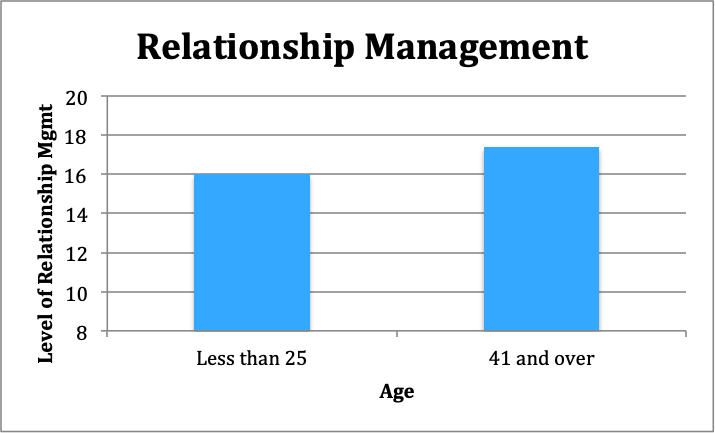
This tendency was confirmed by a positive correlation of 0.236 between age and relationship management. So we can then conclude that age is a significant factor in improving relationship management.
- Some interesting results were also evident when clear/unclear values measurements were compared with emotional coaching, self-motivation and relationship management.
Clear values related to self-motivation produced significantly positive correlations of between 0.284 and 0.319. While unclear values linked to emotional coaching showed a negative correlation of -0.94. Once again, this demonstrates that having clear values is a desirable characteristics for any contact centre advisor who wants to be effective.
- When examining the results of optimism/pessimism questionnaire and linking them to emotional management, self-motivation and emotional coaching, they produced correlations of between 0.291 and 0.26 with optimism. They correlated negative with pessimism (-0.25 to -0.26).
In addition, the candidates with higher average scores on emotional management (14.8 to 13.8) appeared to be a lot happier. This trend confirms that EI factors relate favourably to optimism.
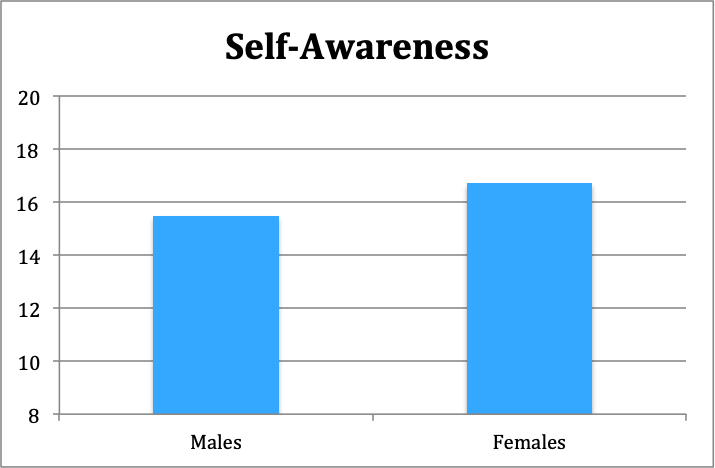
- The self-aware factor indicated that females are more conscious of this issue, scoring 16.71, while males only averaged 15.49.
- Finally, the results comparing emotional management and experience were rather erratic and didn’t produce meaningful results.
As a result of T2’s wide experience in the behavioural sciences and from the research conducted both at universities and in numerous companies over the past 20 years, we have identified eight qualities which we believe will improve your EI:
- empathy, helpfulness and understanding
- passion, belief and commitment
- satisfaction of your needs and wants
- optimism and positive thinking
- adaptability and flexibility – the essence of change
- control of your feelings
- acceptance of criticism
- defence against emotional sabotage.
These important attributes will lead to higher performance, less emotional stress, improved decision-making, more resilience and wellbeing.
—
Dr Henry Fabian, Registered Clinical Psychologist
Come Out, Come Out Wherever You Are…
Why is it that Customer Service Directors, or Customer Service Managers, can’t be contacted by customers?
Isn’t their job to be the link between a Company and its customers? Aren’t they the people who are ‘passionate’ about customer service? Isn’t that their raison d’être?
George Smiley with all his brilliance had less trouble hunting down a mole in the Circus, than most customers have hunting down Customer Service Directors in big companies.
Twenty years ago, it was possible to pick up the phone and actually get through to a Customer Service Director. I know that for a fact. I did it on a regular basis. Now Customer Service Directors – even Customer Service Managers – are just too important to talk to customers.
They’re busy managing the thousands of Customer Service Advisors they hide behind.
The trouble is front line Advisors operate within strict guidelines and have very little power to keep customers satisfied, most of whom try to get to a decision-maker in the hope of a more favourable response to whatever’s bothering them.
And if one a disgruntled customer should get to the guy at the top, it’s jackpot time. Customers know that if you’re talking to someone who’s used to dealing with £millions, £50 compensation is nothing more than small change found on the side of the road.
It’s been a game of hide and seek over the past twenty years and front-line staff have found very creative ways of reducing the stress of having to keep customers from getting to their senior colleagues.
In one Company, Advisors all called themselves Manager, and simply switched phones between themselves whenever a customer wanted to escalate the conversation. In another, they took turns to be the Manager on different days of the week.
So guess what. You won.
Customers have given up trying to get hold of you – but they’re sore losers and they’re taking revenge: Facebook, Twitter, Instagram, that’s where it’s at.
Game on!
—
Dr Valerie Bram is a Director at T2 – valeriebram@t2linguistics.com