“One machine can do the work of fifty ordinary men.
No machine can do the work of one extraordinary man.”
– Elbert Hubbard
Read the latest news about technological developments, or skim through this year’s customer service conferences, and it’s pretty clear that most customer service jobs are going to be taken over by robots.
According to research, 35% of current jobs in the UK will likely be computerized by 2030.
While in the immediate future, 6% of all US jobs will be eliminated as a consequence of automation in only four years’ time.
Automation is nothing we haven’t witnessed before. The last 100 years have seen factory workers replaced by machines, and front-line staff across a number of industries – from hospitality to retail and travel – by self-service kiosks.
In 2015, the first hotel staffed entirely by robots opened in Japan.
In 2017, Robocop joined the Dubai Police.
At the start of 2018, NatWest hired – on probation – life-like virtual teller, Cora, to answer up to 200 basic questions. Amazon then went a step further launching its first supermarket without humans, self-service, or checkouts in Seattle, allowing customers to scan items and then pay using smartphones.
But there are also hybrid machines out there. At Orlando Airport, I watched customers avoid the queues for car hire companies and race up to video kiosks that combined the inter-personal skills of humans and with the efficiency of machines. It was a classic case of offering the convenience of self-service, with the expertise of a human ‘on demand’.
In reality, they were frequently abandoned in the end. The slightest technological glitch had customers heading for the human behind the counter.
But if you’re thinking of doing a ‘Canute’, don’t waste your time. Universal, commercial imperatives in today’s competitive world are about cutting costs and maximising profits. While Utopia for customers is to be found in increasingly fast, efficient, unbiased, personal service.
Which is why both sides are optimistic about the impact of robots and why AI is high on the agenda for the customer service industry.
But a word of caution, and it’s coming from an unexpected source. Hollywood always seem to be ahead of the curve when it comes to talking about scientific advancements. Creative minds in the media have not only anticipated future robotic tends, they have also anticipated problems.
In 2017 we wondered all how Harrison Ford and the love of his life – the green-eyed robot Rachel – managed to have a child together.
In 1975, Bryan Forbes scared us to death with the apocalyptic vision of men swapping their wives for robotic replicas in The Stepford Wives. Poor Catherine Ross.
And who can forget, way back in 1966, Wendy Craig’s relationship with her home help? Advanced publicity asked, “Can a man-like robot do everything a man can do: but willingly, obediently and tirelessly?” Oh yes, he could.
So, what are the current attitudes about the impending tsunami of robots in customer service?
Over the course of three months, we surveyed over 200 people between aged between 16 and 87, of all genders and backgrounds, working for private and public/government organisations.
The aim, on the one hand, was to find out if people are happy talking to a robot, or to a human being, and then to establish whether people thought humans or machines were more trustworthy.
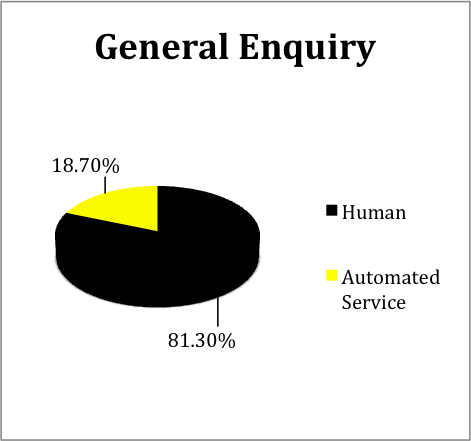
In standard customer service scenarios, such as general enquiries, 81.3% of participants said they prefer to interact with humans rather than robots.
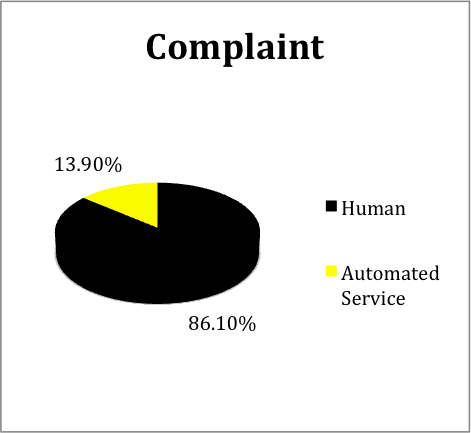
The percentage increased to 86.1% for complex situations, such as complaints, where we can only assume customers believe human beings will come up with suitable, creative solutions that may not be programmed into a machine.
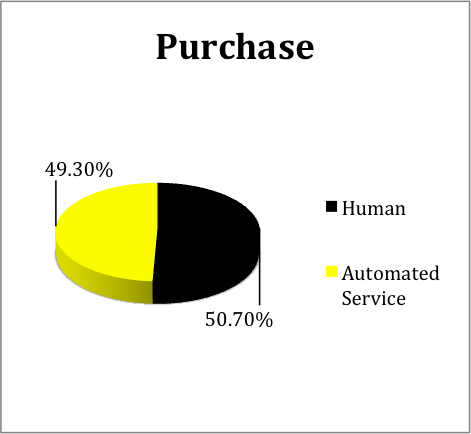
But when simply making a purchase, the results slightly different: here, only 50.7% of the respondents claimed they would rather deal with a member of staff over an automated service.
Since most customer decisions are based on emotion, rather than logic, the industry should take note of the most powerful indicator of customer satisfaction: the ability to trust the person and – by implication – the company they are dealing with.
The great majority of people (82.4%) said they trust humans more than machines. This could be said to be an anomaly, since, machines are programmed by humans. Don’t look for logic. This is pure emotion.
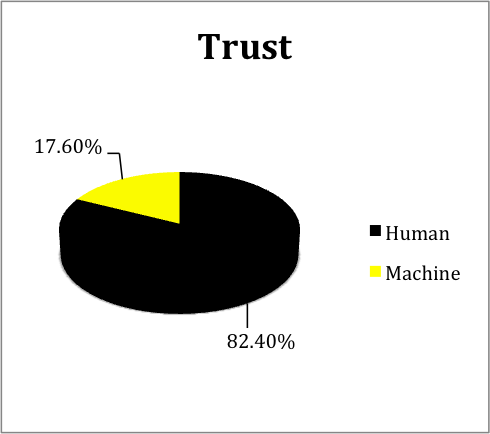
So it appears, overall, that people still prefer to deal with people, and – against all odds – trust them significantly more than robots.
Bots might be cheaper and faster, but they can’t yet display the same level of reliability, trust, empathy and creativity that humans value most of all, and that well-trained, engaged and committed front-line staff deliver. Nor can we foresee when machines will embody all these quintessentially human hallmarks in the future, in spite of Hollywood hype.
Until then, it seems we’re set to live a customer service paradox: human preference versus machine predominance.
AI is happening, whether we’re ready for it or not. Robots may increasingly take over more basic customer service tasks, but humans will continue to be indispensable for escalated complaints, complex questions, or sensitive issues.
What Can We Learn from Olympic Success?
Watching the peak performance of Olympic champions in PyeongChang with amazement and awe, we can only marvel at how athletes achieve such phenomenal levels of success.
What are the secrets of mastery at this level – of the staggering courage of men and women who hurtle through the crisp, cold winder air with nothing more than two long thin skis, or a four-foot piece of wood to support them? What do they know that we don’t?
Can we accomplish personal growth and leadership at work using the same techniques?
We certainly can. Here are three secret strategies of Olympic champions that executives and managers can use to guarantee personal success.
1. The Power of Habit
This essential characteristic is stressed by Malcolm Gladwell in his best-selling book entitled Outliers: The Story of Success. Gladwell highlights two key elements of success – practice and repetition – which are crucial even when talent or a special aptitude are already sky high. Each of gold medallist has stressed these two fundamental elements.
No-one can really become proficient in any undertaking without constant repetition. It’s practice that gives Champions the confidence and assurance to perform at the highest possible level, according to Gladwell.
The power of habit establishes a pattern of behaviour that becomes wired into our nervous system, which kicks in to activate desirable modes of reaction. These in-built actions were also highlighted by William James, the famous American philosopher, in his magnificent book Habit. James recommends we use our nervous system as our ally, and that we use the power of habit to override negative pull. So, introducing these characteristics at our work would be highly beneficial.
An outstanding example of all these attributes was in the performance of Easter Ledecka of the Czech Republic. She won two gold medals: one in the parallel slalom and the second in the alpine skiing super G in the 2018 Winter Games. She said it was hard to achieve both, but practice and wiring certain behaviours into her DNA gave her the confidence to battle to succeed in both events. She loves both disciplines and trains for each – three weeks snowboarding and a subsequent three weeks of skiing.
2. The Power of Criticism
People hate to be criticised.
Criticism is frequently viewed as unfavourable – we prefer not to be reminded of our weaknesses.
But a very successful Olympic American alpine skier, Bode Miller, who won six medals said, “People don’t like to admit they have flaws. Instead they prefer to focus on their strengths.”
The problem with this attitude is that you limit how much you could improve, as your strengths are already there, and you are forced to concentrate on making minimal improvements in an already high standard of performance. In fact, there is more scope in reducing your weaknesses.
Miller decided to focus on reducing his weaknesses and his performance improved substantially.
The moral of this secret is ‘Don’t be afraid to admit your flaws; it might help you in your personal development’.
3. The Power of Imagination
The famous poet Judah Halevi defines a truly great person as one who has complete control over his/her mind and has the uncanny ability to visualise events.
He was referring to the skill of mentally rehearsing potential roadblocks in advance, which would mean that you could prepare and train for the unexpected.
Take for example Bob Bowman, who was the swimming coach of 23-time Olympic winner gold medallist Michael Phelps. Under his tutelage, Phelps was named American swimmer of the year from 2001 to 2004. What Bowman stressed to his star student was the concept of mental visualisation. This proved to be very useful for the champion swimmer, as Bowman taught him that things can sometimes go wrong and you have two choices: you can either view them as a disaster and mentally knock yourself, or you can look at the situation as a challenge. By anticipating bad things happening, you can mentally rehearse how to handle them.
Another application of this concept was highlighted by the captain of USA gold medal women’s hockey team after the USA beat Canada. She said with great enthusiasm, “We knew we were going to win. We played this game 20 times over in our heads.”
It would not be difficult for senior business leaders to adapt and use these three secrets of Olympian success in their business lives. There’s a gold medal and winner’s podium waiting out there for those with the determination to give it their all.
Dr Henry Fabian is a Director of T2: www.t2linguistics.com.
The Best of All Possible Worlds: How Social and Active Hobbies Benefit Optimism
Voltaire is one of the first Europeans to have been called a pessimist, and his Candide (1759) is a well-know satire of an optimist who naively believes that “all is for the best in the best of all possible worlds”.
Voltaire also famously claimed that “Optimism is the madness of insisting that all is well when we are miserable”.
Fast-forward three centuries, and it turns out that Voltaire – along with any modern-age cynic – could have had a better, healthier life had he been a little more optimistic.
Since the foundation of Positive Psychology by Martin Seligman in 1998 – the branch of psychology concerned with people’s strengths, happiness and optimism, and revolving around the study of PERMA, namely positive motions and relationships, engagement, meaning and accomplishment – research on the benefits of practicing optimisms has skyrocketed.
It may sound too good to be true, but optimistic people are proven to benefit from a stronger immune system and cardiovascular health, and also have a lower risk of developing cancer. On the other hand, highly pessimistic people tend to suffer from depression more regularly, they underachieve in their professional lives, and their relationships are more often than not rocky (Seligman 2011).
Research we recently carried out in the contact centre of a prominent UK Government Agency shows how hobbies influence the optimism of call handlers. It emerged that people with social and active pastimes display higher levels of optimism than those with sedentary interests.
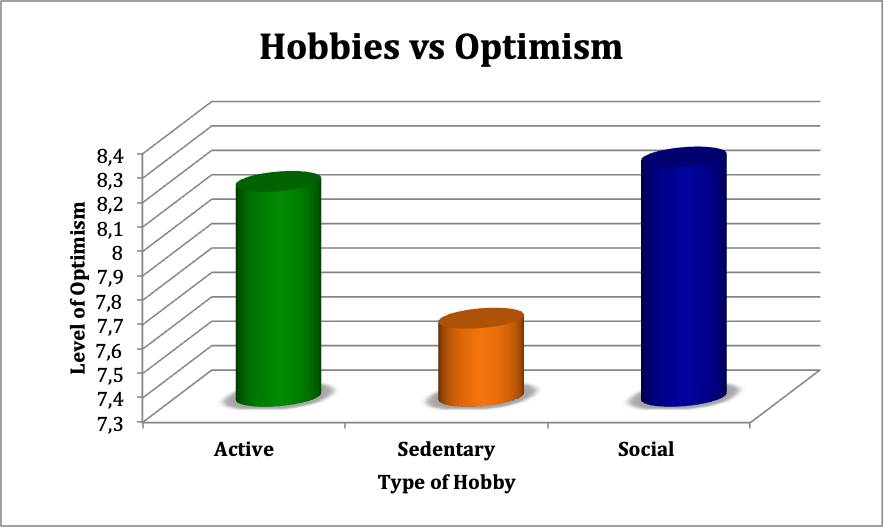
Our results support those obtained from other studies that throw light on the reasons why optimists enjoy better mental and physical health. The two main reasons for this are that they are able to count on a stable social support network and they have a healthy lifestyle (Seligman 2011).
So not only do contact centre advisors with social hobbies have a more collaborative approach to resolving conflict situations (see “The Other Side of Hobbies”, 1 February 2018), but they are also intrinsically more optimistic – two ideal features in customer service roles.
These conclusions support the trend that many companies now encourage their employees to join social and wellbeing activities – often for discounted prices.
References
Martin Seligman, Flourish: A New Understanding of Happiness and Well-being, and How to Achieve Them (2011)
How Emotionally Agile Are You?
According to Google and Harvard University there are 1,022,000 words in the English language. But according to Susan David, a well-known author and Professor of Psychology, we only use about 16,000 of them every day.
The emphasis today is on emotional agility and intelligence in the workplace. So using words in a smarter way will improve your social skills, which in turn will offer a wider range of career opportunities.
Focusing on how, why, when and where your emotions contribute to your behaviour and decision-making, or where they sabotage your thinking, will help in all areas of your life.
When you understand your feelings and emotions better, you’ll have a practical tool to target the personality traits you want to improve. Developing your strengths, will help you achieve the outcomes you value most.
Equally it will help reduce conflict in interpersonal relationships – with bosses, colleagues, family and friends. You’ll also be able to assert your own interests, while respecting those of others.
The best way to benchmark the current level of your emotional agility is to complete an EI Questionnaire. This instrument will provide you with a measure of the five key aspects of EI: self-awareness, emotion management, self-motivation, relationship management, and emotional coaching.
Knowing how you score in these areas will help you at work, where you have to deal with overt issues – strategy, policies, technology, authority and chains of command – as well as covert issues – that include attitudes, perceptions, culture and inter-group conflicts.
Knowing which pitfalls to avoid and which issues will give you a springboard to your goals is often as important as your ability to do the job.
Because of this EI is now in greater demand than innate intelligence.
Studies of 358 managers in 2000 and 2001 proved that Leadership Competencies amongst the emotionally intelligent were higher than those of average performers.
Moreover, women managers scored significantly higher on interpersonal skills and social responsibility then men. However, the latter were more adaptable.
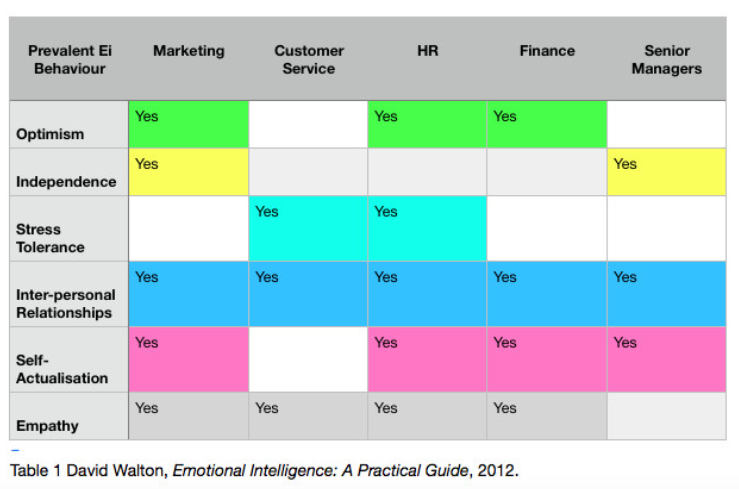
The prominent Harvard Psychologist, David McClelland, studied 30 different organisations. The table below shows some of McClelland’s results for different occupations, and is quoted in Dr David Walton’s book Emotional Intelligence: A Practical Guide.