
T2 has recently delivered its first pilot course for The Ringley Group – comprising surveyors, solicitors, property managers and customer service teams – in the heart of the British Capital.
Mary-Anne Bowring, Group Managing Director, worked with us to establish a Corporate Personality and Tone of Voice for the Group.
“Looking after 10,000 homes means looking after ten thousands families – in one of the most culturally diverse capitals in the world,” she points out.
And in a world where customers’ expectations are constantly rising, Ringley’s ability to understand human needs and master a range of communication styles with its diverse audience is a priority for the Group.
Mary-Anne is now planning to improve Ringley’s written communication, bringing the brand alive across all channels.
If you’d like to improve your Company’s oral and written customer communication, have a look at our service offering and get in touch with us.
Revolutionising a Contact Centre: Mission Accomplished
About one year ago we began working for the DVLA. The Agency is a monopoly – dealing with all the records, enquiries, medical issues and enforcement notices for over 38 million drivers.
The overall aim of the project was to improve the interactions between Agency and customers, increase psychological knowledge and understanding of self and others, develop confidence in persuasive techniques and conflict resolution and, most crucially, train the Contact Centre Representatives in Psycho-Linguistics – a unique combination of Psychology and Language that allows to manage the content of messages as well as customers’ emotional reaction. Put it simply, our mission was to revolutionise the DVLA contact centre.
We conducted an experiment related to telephone conversations from the Agency’s Swansea contact centre that handles calls for the whole of the UK.
Over 547 people evaluated the image of the Organisation based on calls recorded before the training took place. The graph below, which has been produced to scale, illustrates how the Agency used to come across.
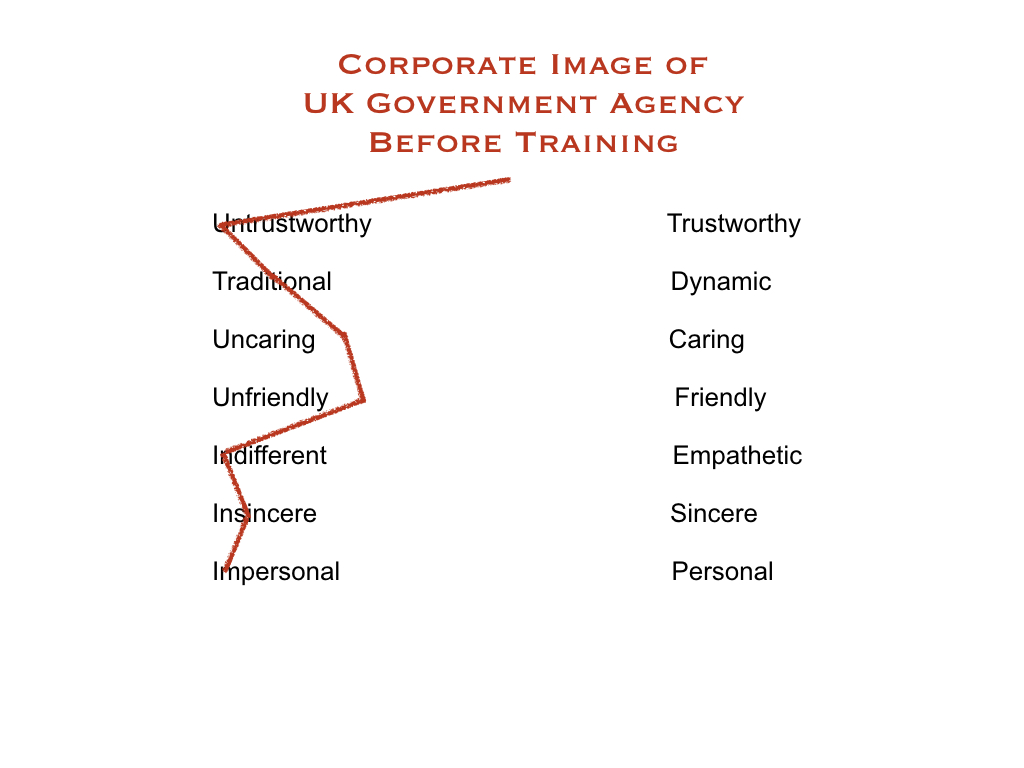
More recently, the image of the Organisation has been re-considered on the basis of calls made by Agency staff who had been trained by our team.
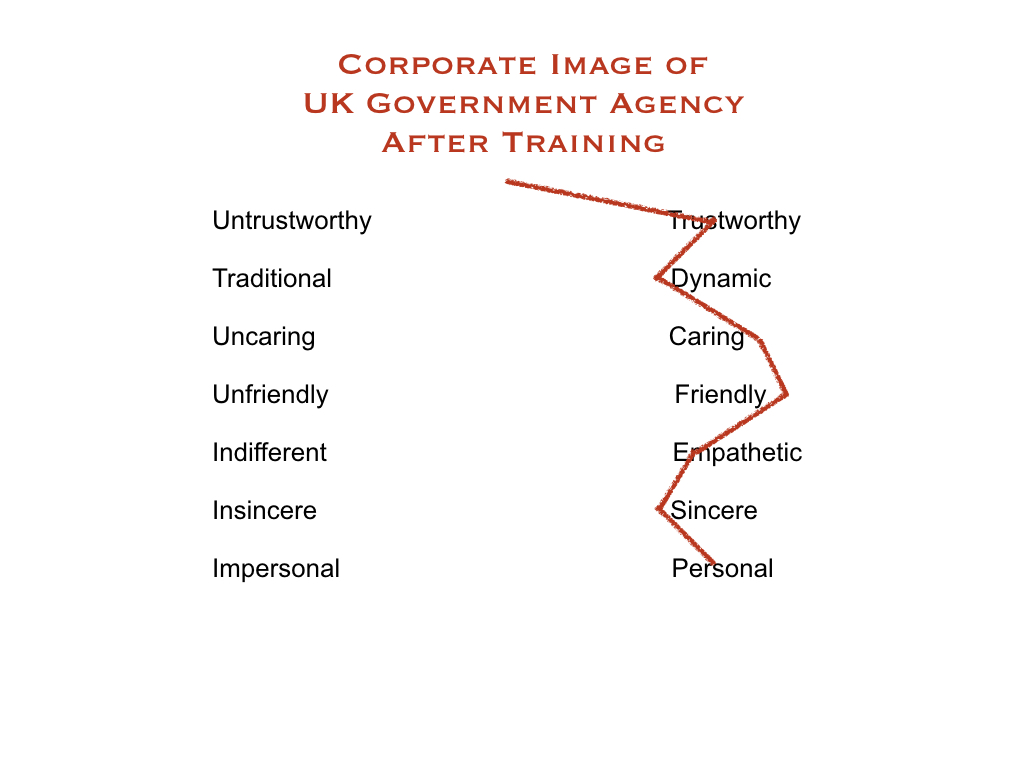
Concepts such as trust, empathy, sincerity and care for the customer moved sharply from left to right. Listeners agreed the tone of voice is now warm, friendly and personal. The overall communication style shifted from formal and traditional to modern, vibrant and dynamic.
Well done, DVLA! Mission accomplished!
Respect & Courtesy: What They Mean to Customers and Companies
Friday, 4 p.m. We are in our usual training room. Everybody’s excited the working week is coming to an end.
The moment we mention the topic of our current research and ask our group to complete a brief questionnaire, several delegates inevitably begin humming the popular 1967 tune: “R-E-S-P-E-C-T / Find out what it means to me”. It’s all laughter. Thank you, Aretha Franklin!
50 years later, we’re still pondering on this powerful word and its true meaning: what does it mean to us? In what ways does the concept of courtesy mean something different? How much of both do we expect and give? And do men and women, young and less young, share the same opinions?
Our initial study proved so surprising and insightful, that we decided to refine our research.
“What it means to me”
We analysed the definitions of ‘respect’ and ‘courtesy’ given by a sample of 167 contact centre advisors from a UK Government Agency.
Courtesy
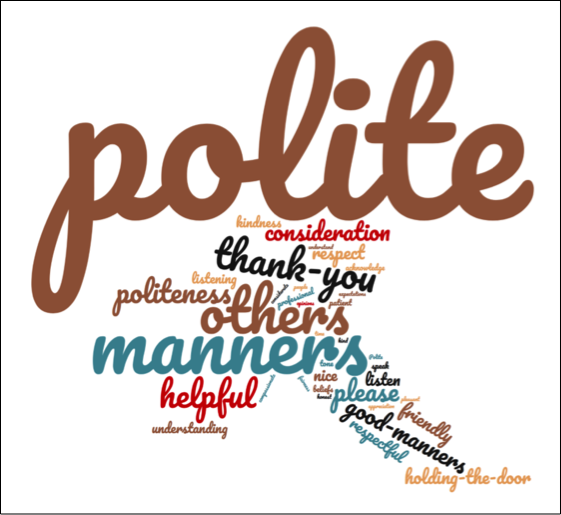
As previously identified, the concept of courtesy is straightforward and well understood. There are no doubts the first word that springs to mind when we think about courtesy is ‘polite’. This reflects the dictionary definition of showing politeness. So far, so good.
Respect
When it comes to respect, things become more complicated.
Overall, the delegates in our sample identified the main aspects of respect as treating others fairly, or understanding and appreciating others’ opinions and views. These definitions are rather divergent from the actual meaning of admiring someone for their abilities, qualities or achievements.
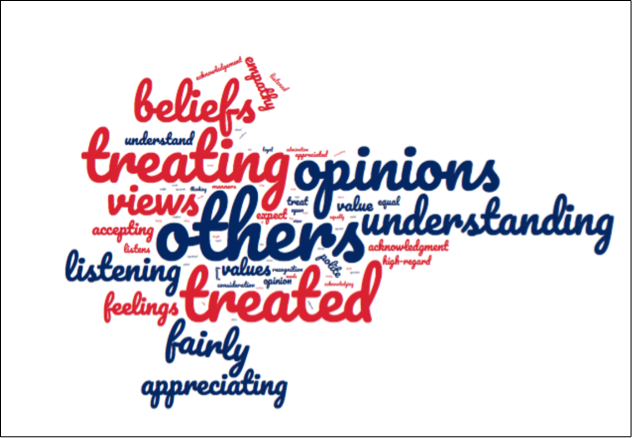
Given the discrepancy between the actual and perceived meaning of respect, this time we also looked for any differences in the definitions given by men and women.
Some gender differences came to the surface: in the definitions given by women, there’s a greater emphasis on words such as ‘feelings’, ‘empathy’ and ‘listening’, which are hardly readable on men’s word cloud.
This shouldn’t come as a surprise: research on gender differences in language has long shown that female communication tends to include more emotional references than men’s, and that it chiefly revolves around feelings. So it’s expected this is also visible in women’s definitions of respect.
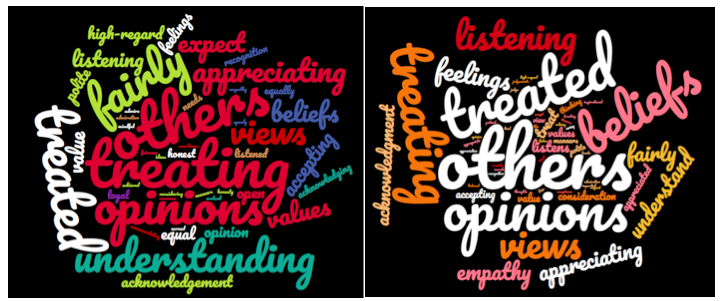
Nonetheless, the core of the definition remains inaccurate – from both sides. Words that we’d expect to read in the dictionary definition of respect, such as admiration for someone’s skills, are virtually unmentioned. Some synonyms (like high-regard and appreciation) are present to a much lesser degree, especially in male definitions.
Which would you rather receive?
Next, we went on to carefully examine what people say they’d rather receive from the companies they deal with. From past studies, we anticipated it was respect. This probably has to do with the widespread distorted interpretation of the concepts of respect and courtesy.
But are there any variations between men and women, or in terms of age?
Although both men and women in all age groups claim they’d prefer to receive respect over courtesy, courtesy becomes increasingly more desirable with age, for both sexes.
What’s more, on average across all age groups, courtesy is more significant for women (30%) than for men (23%).
Interestingly, while 18-to-24-year-old men disclose a strong preference for respect (94%), women over 45 years of age score the highest percentage on want for courtesy (47%).
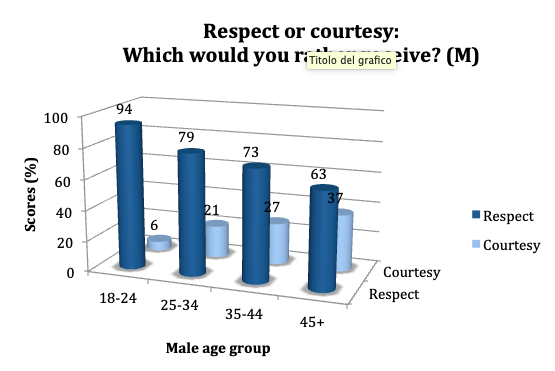
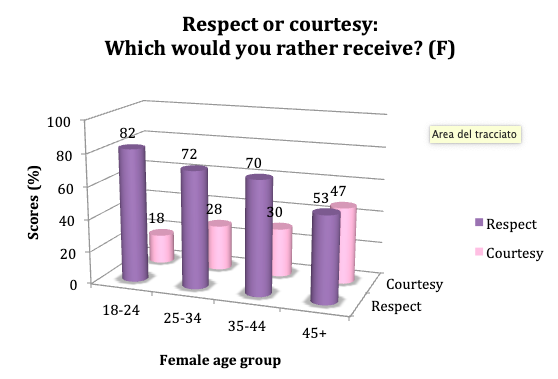
A generational gap seems to emerge: young people are not overly concerned with good manners, and would rather have their opinions recognised and appreciated. This is particularly evident in young men. However, the older generations are not willing to completely give in: women in particular still expect and appreciate good manners.
What can companies learn?
In today’s increasingly competitive market place, there’s more pressure than ever on providing an excellent customer service, increasing sales, and reducing complaints. All of this links to a greater discourse on loyalty, trust, and of course profitability.
So what do these results on respect and courtesy mean for companies?
Organisations might think courtesy and politeness are commercial imperatives. And indeed they are. But the discerning customers of the 21st century also want something else from the companies they deal with: R-E-S-P-E-C-T.
In the 1960s, Aretha Franklin sang about respect “Find out what it means to me”. Today, we’ve come to understand that, from a consumer’s perspective, the denotation and connotation of respect don’t correspond. For customers, respect also implies being treated fairly, listened to, and ultimately feeling that their opinions are being understood and valued.
This highlights the need for companies to adapt the way they talk and write to the changing needs of modern customers, and to further tailor these to different sexes and age groups.
“Everything Must Change”: Adaptability & Age
About 400 million years ago, the first fish crawled out of the sea. Living on land provided a whole new set of challenges: these vertebrates had to learn to breathe, move and eat outside the sea where they had always lived. They discovered very quickly that they had to adapt to survive.
In the modern era, adaptability is a measure of how well individuals deal with change on a personal level. As the saying goes, the only constant is change, and it is something we all have to deal with on a daily basis.
We have been providing Psycho-Linguistic training to a Government Organisation since mid-2016. Psycho-Linguistics is a specialist communication methodology that allows to manage the content of messages as well as customers’ emotional reaction to them. As part of the course, the delegates complete psychological questionnaires on topics such as emotional intelligence and stress. This serves the dual purpose of embedding the key learning points and giving them some insight into their own characteristics and natures. One of the factors we measure is how adaptable each person is, given that highly adaptable people cope better with change. The relevant questionnaire was compiled by our Clinical Psychologist, who has been studying this topic over many years.
We selected a sample of 100 staff from a variety of roles, 51 women and 49 men. Some were contact centre staff, some in team leadership positions, and some from support operational areas. The data included information about age, gender, length of service and adaptability score, which ranged between 12 (very high) and 60 (very low). We carried out an analysis of the data to determine the levels of adaptability of the staff.
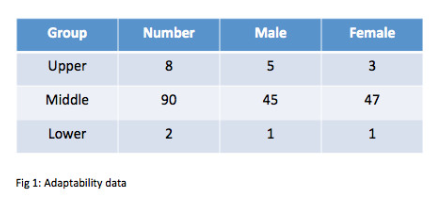
8% of the sample scored in the top 25%, showing very high adaptability: the split was 5% men and 3% women. Only 2% of the sample scored in the lower 25%, one of each gender. The vast majority (90%) fell in the middle 50%, with no significant difference between men and women.
We discovered that there is a weak negative correlation (-0.126) between length of service and adaptability score, and a weak positive correlation (0.017) between age and adaptability. The average adaptability score for this Organisation is 32.6.
When we worked with a private sector utility supplier in 2015 and 2016, we calculated that the average score for delegates was 30.6, based on a sample size of 702. This shows that the private sector employees are more adaptable, to the tune of 6.5% (Figs 2 and 3).
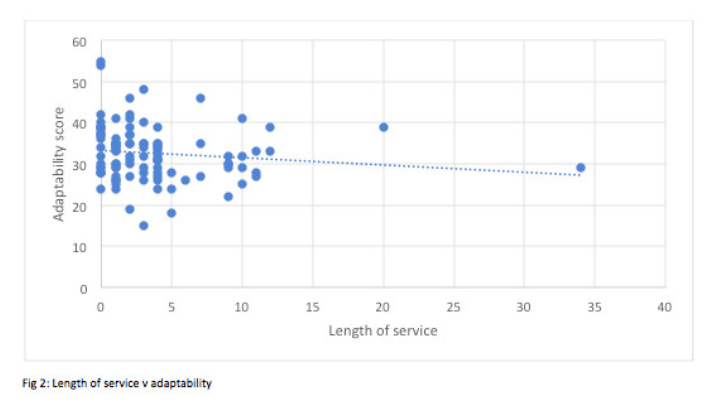
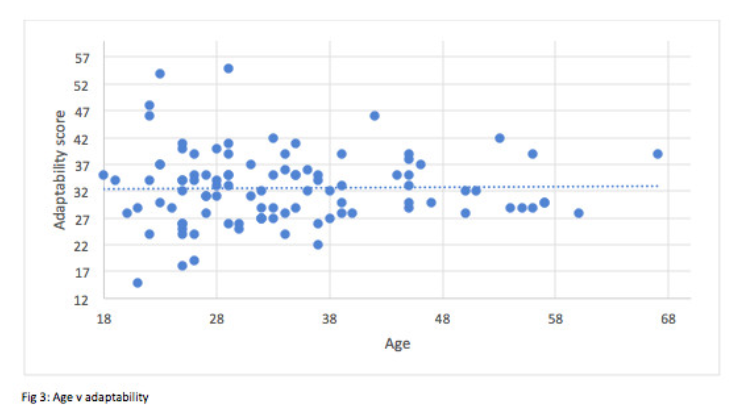
So it seems that staff at a major private sector company are more adaptable than the cohort working in the Civil Service. If this is part of a wider trend, it could point to government employees being more comfortable with the status quo, while private sector workers are more ready for change.
Finally, we compared adaptability scores with length of service for both the public and private sector organisations (Fig 4) and discovered a pattern: staff at both organisations seemed to display high adaptability scores up to five years’ service (33.2 for the government department, 31.7 for the utility provider). Staff between five and ten years’ service showed lower scores (29.6 and 28.2), and those over ten years scored highly again (32.6 and 30.4).
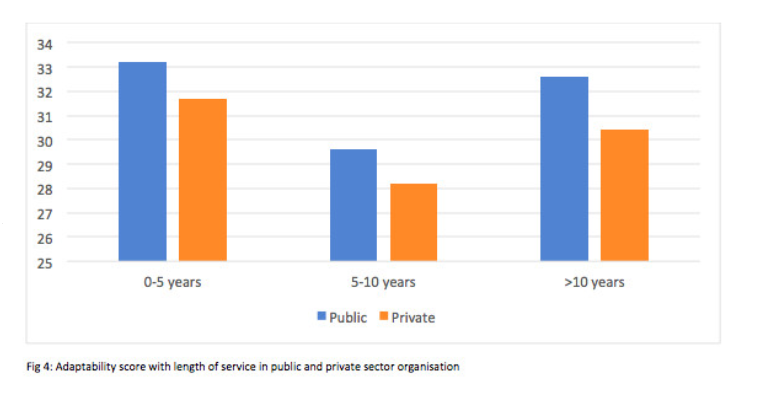
This is an interesting finding and could mean that staff members:
- initially display adaptable behaviour as they learn new skills and master the job
- become a little set in their ways after five years
- then, with experience, they learn to deal better with change, almost to the degree they could initially.
Unexpectedly, the most experienced staff seem to be keen on, and ready for the constant changes the modern business environment demands as much as the early starters. This means that companies who keep their staff long-term – and who invest in them providing training and development initiatives – could reap the benefits as time goes on.
T2 is the world’s leader provider in the commercial application of Psycho-Linguistics. We work across the globe, with clients coming from both the public and private sectors.